

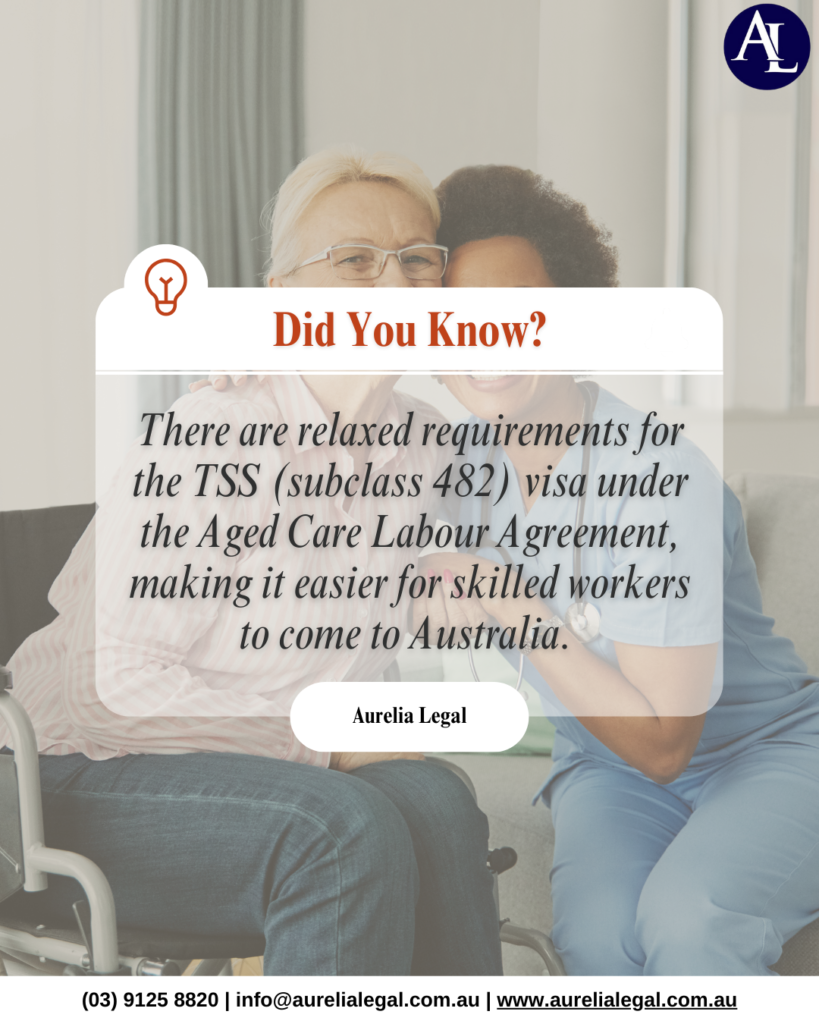
In Australia’s evolving aged care sector, securing a labour agreement offers distinct advantages for employers. Labour agreements provide concessions to standard skilled visa requirements, making it easier to address workforce shortages and improve staff retention. With the recent increased care minutes legislation placing additional pressure on staffing, a labour agreement can help meet these demands. Explore the specific relaxations under the labour agreement and how they benefit employers and employees in the aged care industry.
Benefits to Employers
- Competitive Salary Requirements – Labour agreements provide flexibility in salary requirements. Employers must pay at least $51,222 AUD annually or the Australian Market Salary Rate, whichever is higher. This is significantly lower than the TSMIT requirement of $73,150 AUD, while still ensuring fair compensation for employees.
- Access to Dedicated Staff for Two Years – Employees on the 482 visa are committed to working with the employer for at least two years before they can transition to a 186 ENS visa. This ensures a stable workforce and continuity for your business.
- Meeting Compliance Requirements – With the increased care minutes and the need for 50,000 additional staff by 2025, visas and sponsorships are essential for recruiting and retaining staff in aged care homes. These agreements help ensure that your facility meets compliance standards and staffing needs.
Benefits to Employees
- Two-Year Pathway to Permanent Residence – A key benefit of a labour agreement is the expedited pathway to permanent residency. Employees can transition to permanent residency through the Employer Nomination Scheme (ENS) after just two years, compared to the usual three years. This streamlined process not only helps in securing long-term residency but also reduces job turnover and associated training costs.
- Streamlined Visa Nomination and Priority Processing – Labour agreements facilitate a more efficient visa process, offering streamlined visa nominations and priority processing. This means quicker approval times for visa applications, allowing employees to start their new roles faster and with less waiting.
- No Post-Qualification Work Experience Requirement for 482 Visa – Employees benefit from the waiver of post-qualification work experience requirements under labour agreements. Typically, skilled visa applicants need to show at least two years of work experience, but with a labour agreement, this requirement is relaxed. This opens up opportunities for recent graduates and those new to the workforce.
- English Language Concessions – Labour agreements offer concessions on English language requirements for employees with relevant community language skills. This is especially advantageous in multicultural environments, where multilingual abilities can enhance communication and service delivery.
How Aurelia Legal Can Help
Navigating the process of securing a labour agreement and managing visa applications can be complex. That’s where Aurelia Legal comes in. Our team specializes in helping aged care providers obtain labour agreements from the government and assist with visa applications for staff. We streamline the process, ensuring compliance and efficiency every step of the way. Contact us today to discuss how we can support your recruitment and compliance efforts at +61 3 9125 8820 or info@aurelialegal.com.au