
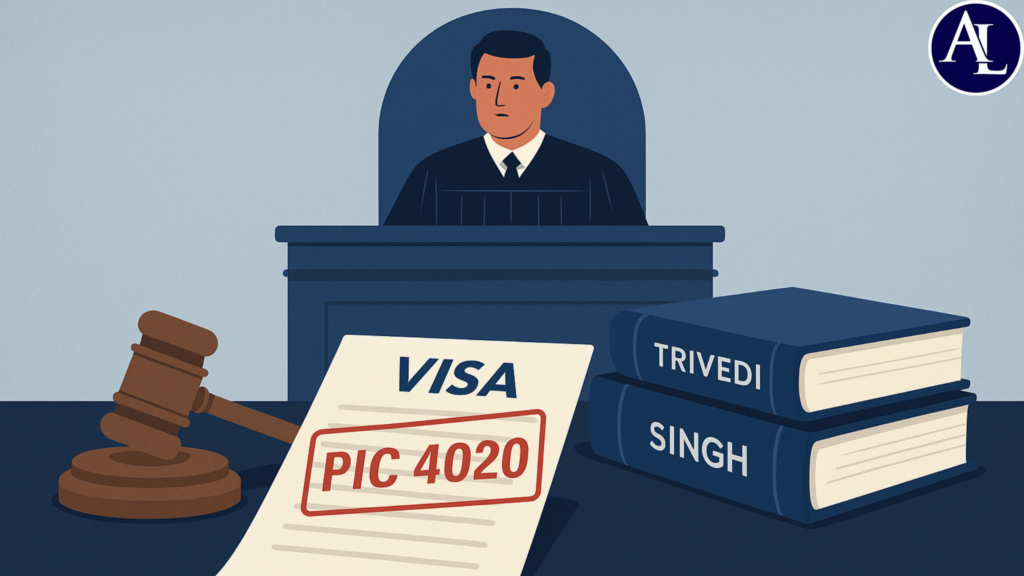
PIC 4020 remains one of the most strictly enforced integrity provisions in Australia’s visa framework. Yet its application is not always clear-cut, and courts and tribunals have played a vital role in interpreting its boundaries.
Below, we break down some of the most significant case law involving PIC 4020, covering key decisions on fraud vs mistake, identity breaches, and how tribunals weigh waiver requests.
Trivedi v Minister for Immigration (2014) [2014] FCAFC 42
Overview: This case clarified that PIC 4020 is designed to address purposefully false information or documents, not innocent or accidental mistakes. Trivedi’s visa application had been refused due to allegedly false information, but the Full Court found that PIC 4020 should not be engaged where the evidence points to an honest or explainable error. The Court emphasised that the “purposeful falsity” lies in the nature of the information or document itself, and that decision-makers do not have to prove the applicant’s subjective intent if the material is, on its face, purposely false.
Key Principles:
- PIC 4020 does not apply to honest errors or minor oversights; the provision targets material with the quality of purposeful falsity.
- Decision-makers are not required to prove that the applicant personally intended to deceive, but the false or misleading material must have that fraudulent quality.
- There is a clear distinction between genuine mistakes (such as typographical errors or misunderstandings) and documents or claims that are counterfeit or fabricated.
Significance: This case is key for defending PIC 4020 refusals where the false material arose from an innocent mistake. It shows context matters, and PIC 4020 is not strict liability for every error.
Singh v Minister for Immigration & Anor [2016] FCCA 774
Overview: The Department refused Mr Singh’s visa under PIC 4020, alleging false information, claiming “proficient” English when his IELTS showed “vocational”. He said it was an innocent mistake, not a lie, and argued the Tribunal ignored his explanation.
Key Issues:
- Does PIC 4020 apply to genuinely innocent mistakes?
- Is the Tribunal obliged to consider the applicant’s explanation that an error was not fraudulent?
- If the Tribunal fails to do so, is it a jurisdictional error?
Held:
- The Court held that the Tribunal must determine whether the applicant’s explanation, that the mistake was innocent, is credible. Failure to do so may amount to a jurisdictional error.
- In this case, other unchallenged findings, such as work history discrepancies and reconstructed payslips, still supported the PIC 4020 refusal.
- Even if the Tribunal erred in not addressing the IELTS misstatement, the error did not affect the outcome.
Significance:
This case confirms a key procedural point: where an applicant claims incorrect information was submitted innocently, the Tribunal is obliged to assess that claim. Ignoring it can breach procedural fairness. However, where multiple independent PIC 4020 breaches exist, one unaddressed innocent error may not be enough to overturn the refusal.
Federal Court and ART Trends: Other Notable Cases
Non-material discrepancies
Tribunals have found that immaterial lies, information that would not affect the visa outcome, may not trigger PIC 4020, as they are not “material particulars.”
Credibility is everything
The ART often accepts waiver requests only when:
- The explanation is detailed and plausible;
- There is strong corroborating evidence (affidavits, letters, etc.);
- The applicant is personally credible and consistent in testimony.
What These Cases Show
- Intent matters: A deliberate lie almost always triggers PIC 4020. An honest mistake may not, but you must prove it.
- Waivers are limited: They’re only available for breaches of 4020(1) and (2), never for identity under 4020(2A).
- Review bodies expect rigour: ART and courts require consistent, well-supported arguments. Decision-makers will treat poorly explained discrepancies as deliberate deception.
- Legal strategy is key: Many successful appeals rely on evidence preparation, clear legal submissions, and early engagement with the Department or ART.
Struggling with PIC 4020? Let us assist.
At Aurelia Legal, we assist with PIC 4020 issues. From waiver requests and natural justice responses to ART and court appeals.
📞 (03) 9125 8820
✉️ info@aurelialegal.com.au
🌐 www.aurelialegal.com.au
Disclaimer: This blog provides general information only and is not legal advice. Outcomes depend on individual circumstances. You should seek advice from a qualified migration lawyer before acting on any information here.