

Australia’s thriving economy and diverse industries often face skill shortages that cannot be met by the local labour market alone. To address this, the Australian Government has introduced Labour Agreements, a tailored solution for businesses to sponsor skilled overseas workers. Whether you’re an employer looking to fill critical roles or simply curious about how these agreements work, this blog will break down everything you need to know. Read more information here.
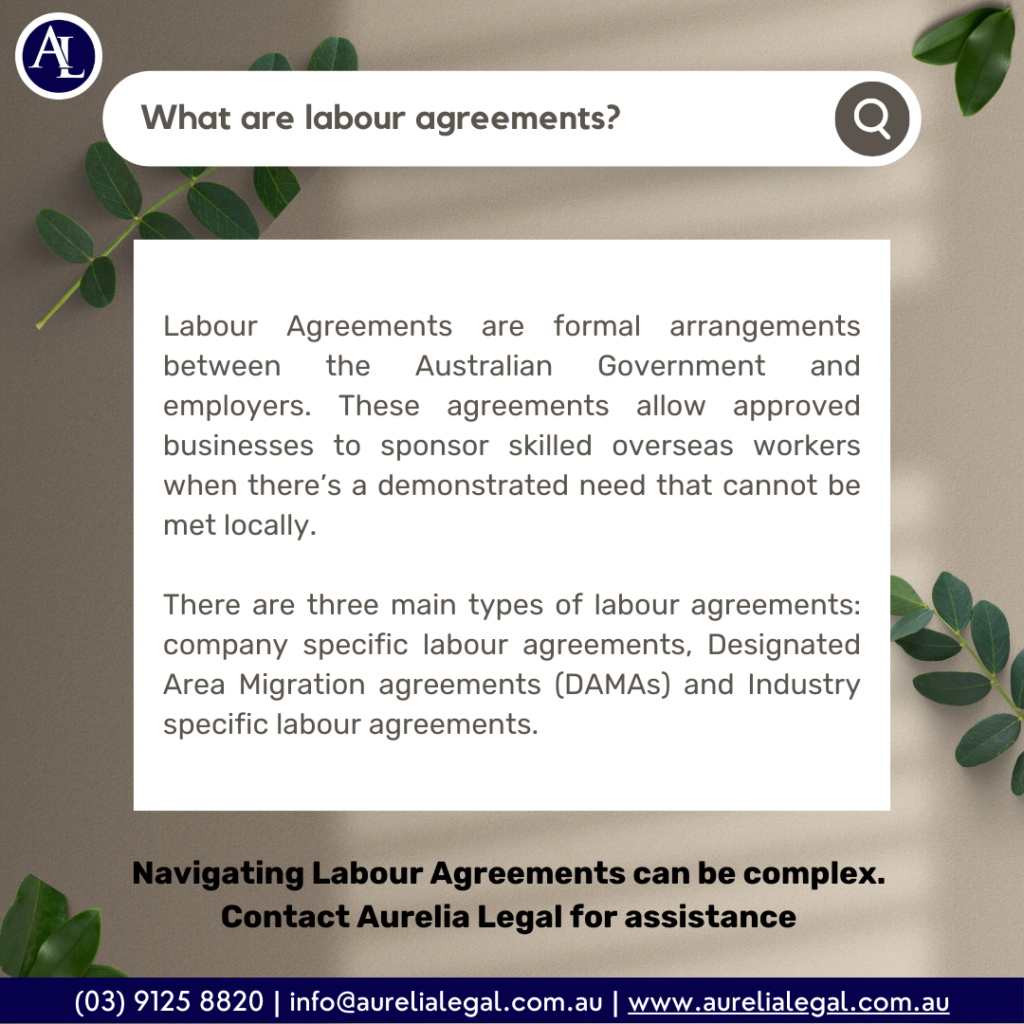
What Are Labour Agreements?
Labour Agreements are formal arrangements between the Australian Government (represented by the Department of Home Affairs) and employers. These agreements allow approved businesses to sponsor skilled overseas workers when there’s a demonstrated need that cannot be met locally. They are typically valid for five years and provide access to visa programs such as:
- Skills in Demand (SID) visa (subclass 482)
- Employer Nomination Scheme visa (subclass 186)
- Skilled Employer Sponsored Regional (Provisional) visa (subclass 494)
These agreements are particularly useful when standard visa programs are not suitable or available.
Types of Labour Agreements
There are three main types of Labour Agreements, each catering to specific industries or circumstances:
- Company Specific Labour Agreements
Tailored for individual businesses with unique needs. - Designated Area Migration Agreements (DAMA)
Regional agreements that allow businesses in specific areas to sponsor workers for roles that may not qualify under standard programs. - Industry Labour Agreements
Sector-specific agreements for industries with widespread skill shortages.
Currently, there are ten industry-specific agreements in place, covering sectors like:
- Advertising
- Aged Care
- Dairy
- Fishing
- Horticulture
- Meat Processing
- Minister of Religion
- On-hire
- Pork
- Restaurant (Premium Dining)
How Do Labour Agreements Work?
Labour Agreements outline the number of skilled overseas workers an employer can nominate annually and specify the eligible visa subclasses and occupations. Here’s a step-by-step overview of the process:
- Nomination Application
Employers must lodge a nomination application for a skilled overseas worker through ImmiAccount. - Visa Application
Once the nomination is lodged, the employer provides the Transaction Reference Number (TRN) to the worker, who then submits their visa application under the relevant visa subclass. - Compliance and Monitoring
Employers must adhere to the terms of the Labour Agreement and meet legislative sponsorship obligations. The Australian Border Force and the Department of Home Affairs may conduct audits or site visits to ensure compliance.
Employer Obligations
Labour Agreements function as contracts, and employers must comply with both the agreement terms and legislative requirements. Key obligations include:
- Ensuring fair wages and working conditions for sponsored workers.
- Meeting training benchmarks for Australian workers.
- Complying with all visa and sponsorship conditions.
Failure to meet these obligations can result in penalties, suspension, or termination of the agreement.
Conclusion
Labour Agreements are an essential tool for Australian businesses struggling with skill shortages. They provide a structured pathway to hire skilled overseas workers while ensuring compliance with government regulations. By understanding the different types and their obligations, employers can make informed decisions to support their workforce needs.
Navigating Labour Agreements can be complex, requiring a deep understanding of immigration laws and compliance requirements. Aurelia Legal specializes in assisting businesses with preparing and negotiating tailored Labour Agreements, ensuring compliance with sponsorship obligations, advising on the most suitable visa pathways, handling nomination and visa applications efficiently, and providing ongoing support for compliance and audits. Our team of immigration law experts is dedicated to helping businesses secure the skilled workforce they need while staying compliant with Australian immigration laws. Contact Aurelia Legal today to explore how we can assist you in streamlining the Labour Agreement process.
Contact us at +61 3 9125 8820 or info@aurelialegal.com.au
DISCLAIMER: This blog is for general information only. Legislation may change from time to time. Please refer to the latest legislation for current details.