

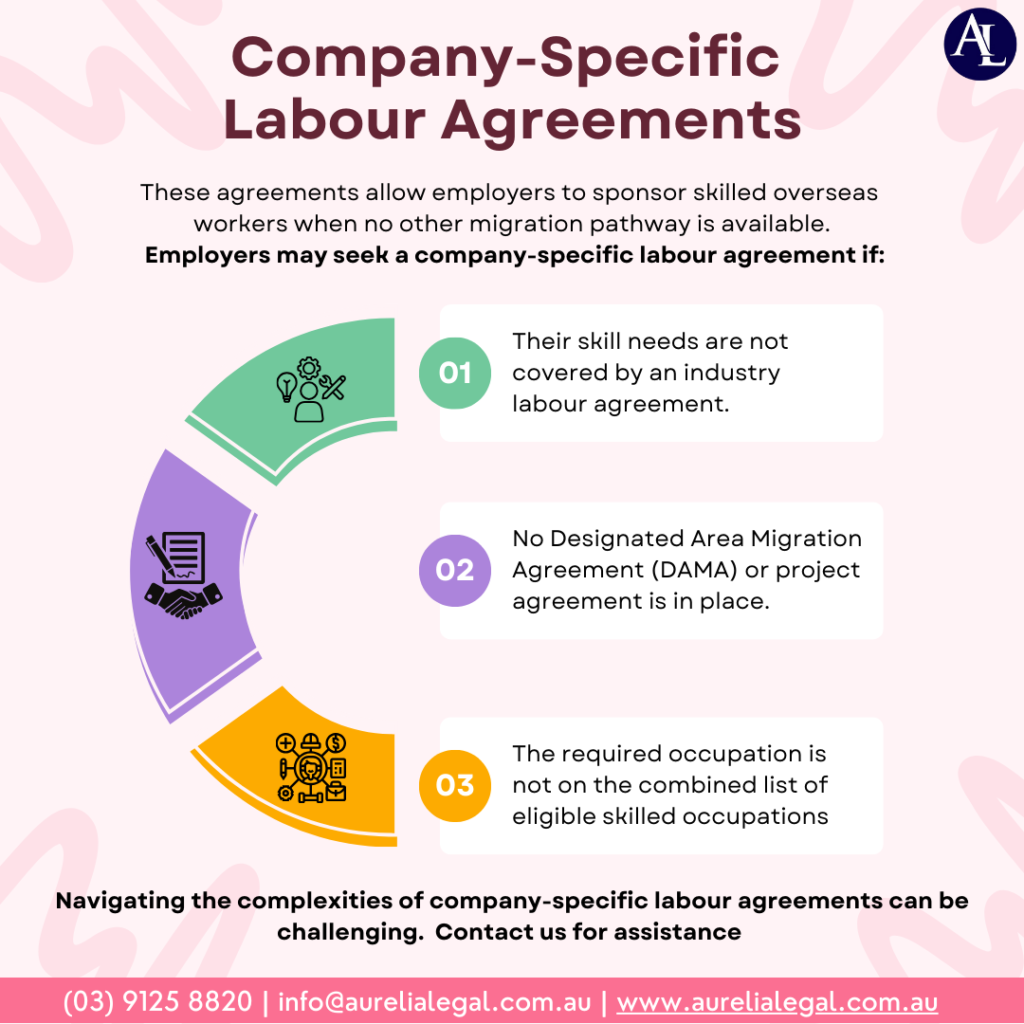
Australia’s company-specific labour agreements provide a tailored solution for businesses facing skill shortages that cannot be addressed through existing visa programs or industry agreements. These agreements allow employers to sponsor skilled overseas workers when no other migration pathway is available.
Who Can Apply for Company-Specific Labour Agreements?
Employers may seek a company-specific labour agreement if:
- Their skill needs are not covered by an industry labour agreement.
- No Designated Area Migration Agreement (DAMA) or project agreement is in place.
- The required occupation is not on the combined list of eligible skilled occupations, unless there is a compelling business case for an exemption.
Demonstrating the Need for Skilled Overseas Workers
To be eligible, businesses must provide evidence of:
- The niche skills required from overseas workers.
- Extensive and diverse recruitment efforts to hire Australian workers.
- A comprehensive job description, including tasks and responsibilities.
The positions must generally align with the Australian and New Zealand Standard Classification of Occupations (ANZSCO) skill levels 1 to 4. However, businesses in Category 3 regional areas may apply for roles classified as ANZSCO skill level 5 in exceptional cases.
Eligibility and Possible Concessions
Skilled overseas workers must:
- Meet the ANZSCO skill requirements for the occupation.
- Hold relevant industry registration or licensing, if applicable.
Businesses may also request concessions to standard visa eligibility criteria, including:
- English language requirements
- Salary thresholds
- Work experience requirements
These concessions apply to the Skills in Demand Visa (Subclass 482) and the Skilled Employer Sponsored Regional (Provisional) Visa (Subclass 494). Businesses may also request a permanent residency pathway via the Employer Nomination Scheme Visa (Subclass 186), with potential age concessions for eligible applicants.
However, any requested concessions must be justified with strong reasoning, ensuring they do not create inconsistencies in employment conditions and salary standards between Australian and overseas workers.
Workforce Planning and Employer Obligations
A company-specific labour agreement is a temporary solution. Employers must demonstrate:
- That overseas workers will not make up more than one-third of the total workforce.
- A plan to train and employ Australians, reducing future reliance on overseas labour.
- Compliance with English language requirements for the Skills in Demand Visa (Subclass 482).
Business Requirements for Approval
Employers must meet the following conditions:
- Be a legally registered Australian business in good standing.
- Have been lawfully and actively operating for at least 12 months.
- Prove financial viability, certified by a chartered or certified practising accountant.
- Have no adverse compliance history, legal breaches, or ongoing investigations.
- Not be insolvent or have a history of providing false or misleading information to authorities.
Industry Stakeholder Consultation
Employers must engage with relevant industry stakeholders, which may include:
- Industry bodies
- Relevant trade unions
- Community groups affected by the agreement (e.g., schools, healthcare services)
Stakeholders must be provided with:
- The number of overseas workers and their occupations.
- Their workplace location.
- Proposed salary levels and award details.
- Any requested concessions.
- Plans for training and upskilling the Australian workforce.
Stakeholders have 10 working days to respond. If no response is received, a follow-up request should be made, allowing an additional 5 working days. Employers must document their consultation efforts when submitting their labour agreement request.
Conclusion
A company-specific labour agreement is a valuable option for businesses that struggle to find skilled workers in Australia. However, securing such an agreement requires extensive documentation, justifications, and stakeholder engagement. Employers must ensure that their workforce planning aligns with long-term sustainability and compliance with immigration laws.
How Aurelia Legal Can Help
Navigating the complexities of company-specific labour agreements can be challenging. Aurelia Legal specializes in immigration law and offers expert guidance to businesses seeking tailored workforce solutions, assisting with preparing a strong business case, managing stakeholder consultations and documentation, advising on potential concessions and compliance requirements, and ensuring a smooth application process with the Department of Home Affairs. With our expertise, we help businesses secure the workforce they need while ensuring full legal compliance. Contact Aurelia Legal today for personalized assistance with your labour agreement application.
Contact us at +61 3 9125 8820 or info@aurelialegal.com.au
DISCLAIMER: This blog is for general information only. Legislation may change from time to time. Please refer to the latest legislation for current details.