

Australia’s Carer Visa provides an avenue for individuals to care for a relative with a significant medical condition or disability. A critical aspect of this visa is the “disability factor,” which is key in determining both the eligibility of the care recipient and the approval of the visa. In this blog, we’ll explore what the disability factor is, how it influences the application process, and the assessments involved in proving it.
What is the Disability Factor?
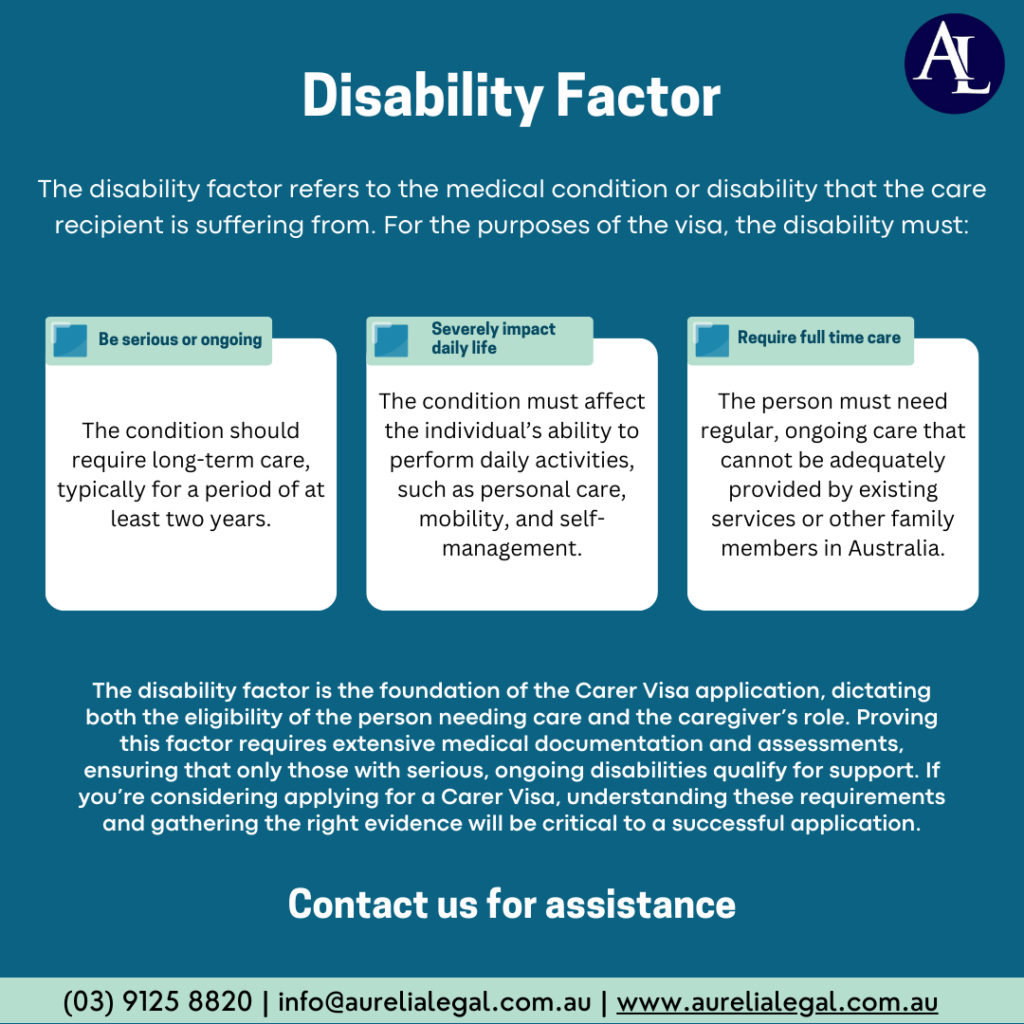
The disability factor refers to the medical condition or disability that the care recipient is suffering from. For the purposes of the visa, the disability must:
- Be serious and ongoing: The condition should require long-term care, typically for a period of at least two years.
- Severely impact daily life: The condition must affect the individual’s ability to perform daily activities, such as personal care, mobility, and self-management.
- Require full-time care: The person must need regular, ongoing care that cannot be adequately provided by existing services or other family members in Australia.
This means that a temporary illness or minor disability would not meet the threshold for the disability factor. It needs to be a permanent or long-term condition with significant consequences on the individual’s ability to live independently.
How Can the Disability Factor Be Proven?
To meet the criteria for a carer visa, proving the disability factor involves several steps, including:
- Medical Evidence:
The application must include medical reports from a qualified doctor or specialist, detailing the nature, severity, and expected duration of the disability. The Australian government typically requires an independent medical assessment from Bupa Medical Visa Services, which assesses whether the condition qualifies under visa requirements. - Centrelink Health and Medical Assessment:
The care recipient may need to undergo a further assessment by Centrelink, which will evaluate whether the disability requires full-time, ongoing care. This assessment determines the level of care necessary and whether it can be provided through existing Australian services or requires a carer from overseas. - Documentation of Care Needs:
The application must clearly demonstrate that the care recipient cannot access adequate care from community services, healthcare providers, or family members already living in Australia. This includes evidence that no suitable care arrangements are available within Australia and that without a carer, the individual’s condition would deteriorate. - Government Form 40:
The visa applicant is required to submit Form 40, which includes details of the care recipient’s disability. The form asks for medical records and evidence of the care needs, which must align with the disability factor requirements.
How Does the Disability Factor Influence the Application Process?
The disability factor directly impacts both the care recipient’s eligibility and the carer visa application. Here’s how:
- Determination of Care Need:
The disability must be such that the person requires long-term, full-time care. This need is proven through medical and Centrelink assessments, which confirm that the care recipient cannot manage daily tasks independently. - Limited Access to Alternative Care:
The government will also assess whether the care recipient can access any support services already available in Australia. The disability factor is critical in proving that no alternative care options exist, making the carer’s role essential. - Caregiver’s Commitment:
The applicant must prove they are ready to provide full-time, unpaid care for the person with a disability. This is not only a significant personal commitment but a requirement for the visa, as the government will approve the application based on the caregiver’s ability to fulfill this role.
Required Assessments
In addition to medical documentation, the following assessments are required:
- Bupa Medical Services Assessment:
An independent medical examination by Bupa will confirm the extent of the disability and whether it meets the visa’s standards for requiring full-time care. The results directly influence whether the application is approved. - Centrelink Health Assessment:
Centrelink’s evaluation determines whether the disability truly necessitates a full-time carer. They assess whether any government or community services could meet the care needs before a carer visa is considered.
Conclusion
The disability factor is the foundation of the Carer Visa application, dictating both the eligibility of the person needing care and the caregiver’s role. Proving this factor requires extensive medical documentation and assessments, ensuring that only those with serious, ongoing disabilities qualify for support. If you’re considering applying for a Carer Visa, understanding these requirements and gathering the right evidence will be critical to a successful application.
Aurelia Legal specializes in guiding clients through the Carer Visa application process, offering expert advice and helping you build a compelling case for your application. By working with us, you’ll gain clarity, confidence, and personalized support at each step of the Carer Visa process, increasing your chances of a successful outcome.
Contact us at +61 3 9125 8820or info@aurelialegal.com.au
DISCLAIMER: This blog is for general information only. Legislation may change from time to time. Please refer to the latest legislation for current details.
Very good service and gives quality assurance to the clients.