

Australia offers several visa options for parents of settled Australian citizens, permanent residents, and eligible New Zealand citizens to reunite with their children. These visas are available in temporary and permanent categories, allowing parents to visit temporarily or settle permanently in Australia. However, due to high demand and limited visa spots each year, processing times can be lengthy. Below is an overview of the key parent visa options. You can read more details here
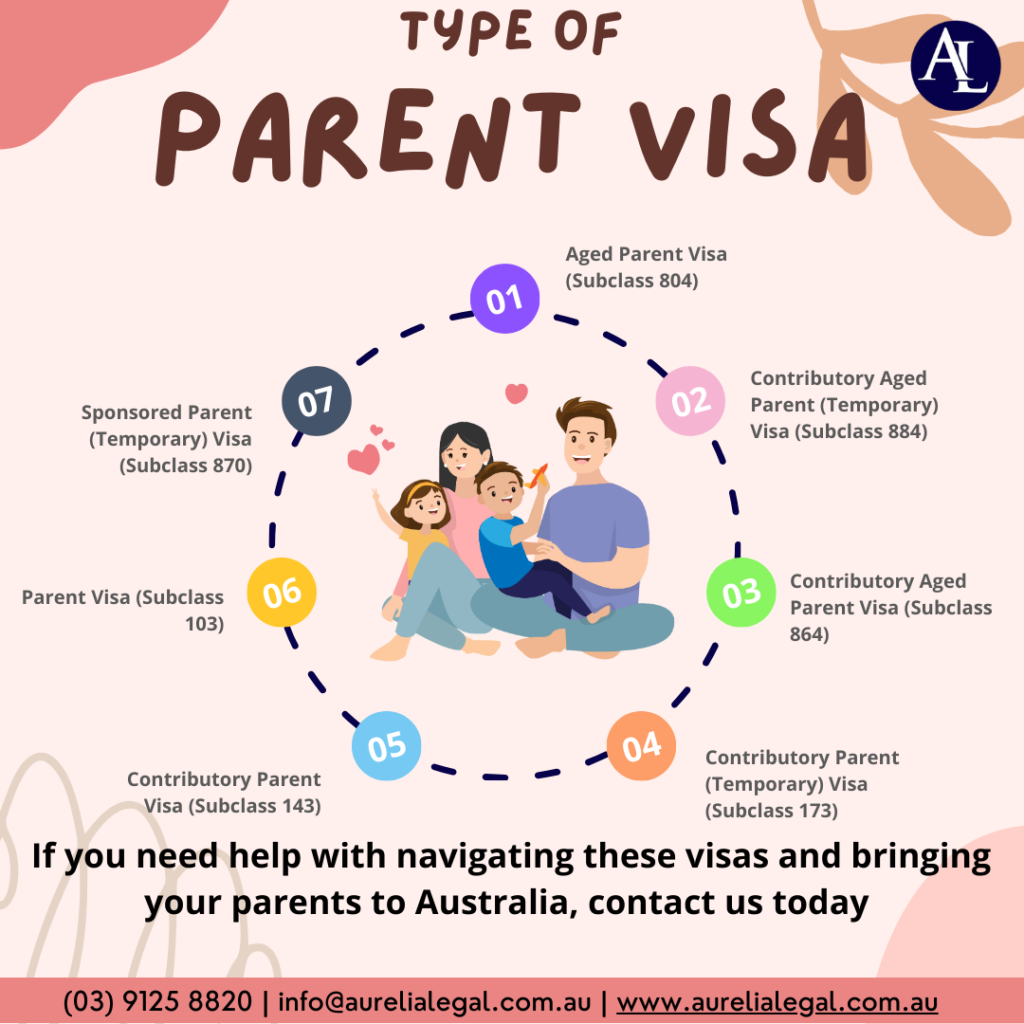
Onshore Parent Visas
Onshore parent visas are for parents who are already in Australia and wish to apply for residency while staying in the country. These visas offer the advantage of allowing applicants to remain in Australia on a bridging visa while their application is being processed.
Aged Parent Visa (Subclass 804)
This visa is for parents who are of retirement age and wish to live permanently in Australia. The applicant must meet the Balance of Family test, meaning that at least half of their children are Australian citizens or permanent residents.
- Processing Time: Can take up to 30 years due to limited places.
- Benefits: Applicants can stay in Australia on a bridging visa while waiting for their visa decision.
Contributory Aged Parent (Temporary) Visa (Subclass 884)
This temporary visa allows aged parents to live in Australia for two years. During this time, they can apply for the permanent Contributory Aged Parent Visa (Subclass 864). Like other contributory visas, this option has a faster processing time due to the higher visa fee.
- Processing Time: 5-6 years.
- Benefits: Offers a pathway to permanent residency through the Subclass 864 visa.
Contributory Aged Parent Visa (Subclass 864)
A faster alternative to the Aged Parent Visa, this visa is also for retirement-aged parents who meet the Balance of Family test. However, it comes with a significantly higher application fee.
- Processing Time: Typically processed within 5-6 years.
- Benefits: Allows parents to stay on a bridging visa while the application is being processed, with faster processing times than non-contributory options.
Offshore Parent Visas
Offshore parent visas require the parent to apply from outside Australia and remain offshore while the visa is processed. These visas are ideal for parents who are not already in Australia or who prefer to apply from their home country.
Contributory Parent Visa (Subclass 173 – Temporary)
This visa is the temporary counterpart to the Contributory Parent Visa (Subclass 143). It allows parents to enter and stay in Australia temporarily for up to two years. Parents can then apply for the permanent Contributory Parent Visa (Subclass 143).
- Processing Time: 4-6 years.
- Benefits: Offers a pathway to permanent residency via the Subclass 143 visa.
Contributory Parent Visa (Subclass 143 – Permanent)
This is a permanent visa option for parents who can afford to pay a higher visa fee for faster processing. Applicants must meet the Balance of Family test.
- Processing Time: 4-6 years.
- Benefits: Once granted, the visa provides permanent residency, allowing parents to live and work in Australia.
Parent Visa (Subclass 103)
This permanent visa allows parents to live in Australia but has an extremely long waiting period due to limited visa quotas. Applicants must meet the Balance of Family test.
- Processing Time: Up to 30 years.
- Benefits: Grants permanent residency with access to Medicare and other benefits.
Sponsored Parent (Temporary) Visa (Subclass 870)
This temporary visa allows parents to stay in Australia for up to five years, with the possibility of renewal for an additional five years. It does not require the Balance of Family test, making it an attractive option for parents who don’t meet that requirement.
- Processing Time: Several months.
- Benefits: Ideal for parents wanting to visit Australia for extended periods without applying for permanent residency.
Processing Times and Caps
Parent visas, except the Sponsored Parent (Temporary) visa, are subject to annual capping and queuing. This means once the cap is reached for a given year, no more visas are granted until the next migration program year, leading to longer waiting periods.
Conclusion
Parent visas provide various pathways for families to reunite, whether temporarily or permanently. While contributory visas offer faster processing times at a higher cost, non-contributory options are more affordable but come with lengthy waiting times. The right visa option depends on your circumstances, including age, location, and financial situation.
Contact us at +61 3 9125 8820 or info@aurelialegal.com.au
DISCLAIMER: This blog is for general information only. Legislation may change from time to time. Please refer to the latest legislation for current details.